
Simple Cortex · Homepage · simplecortex.com
3 points
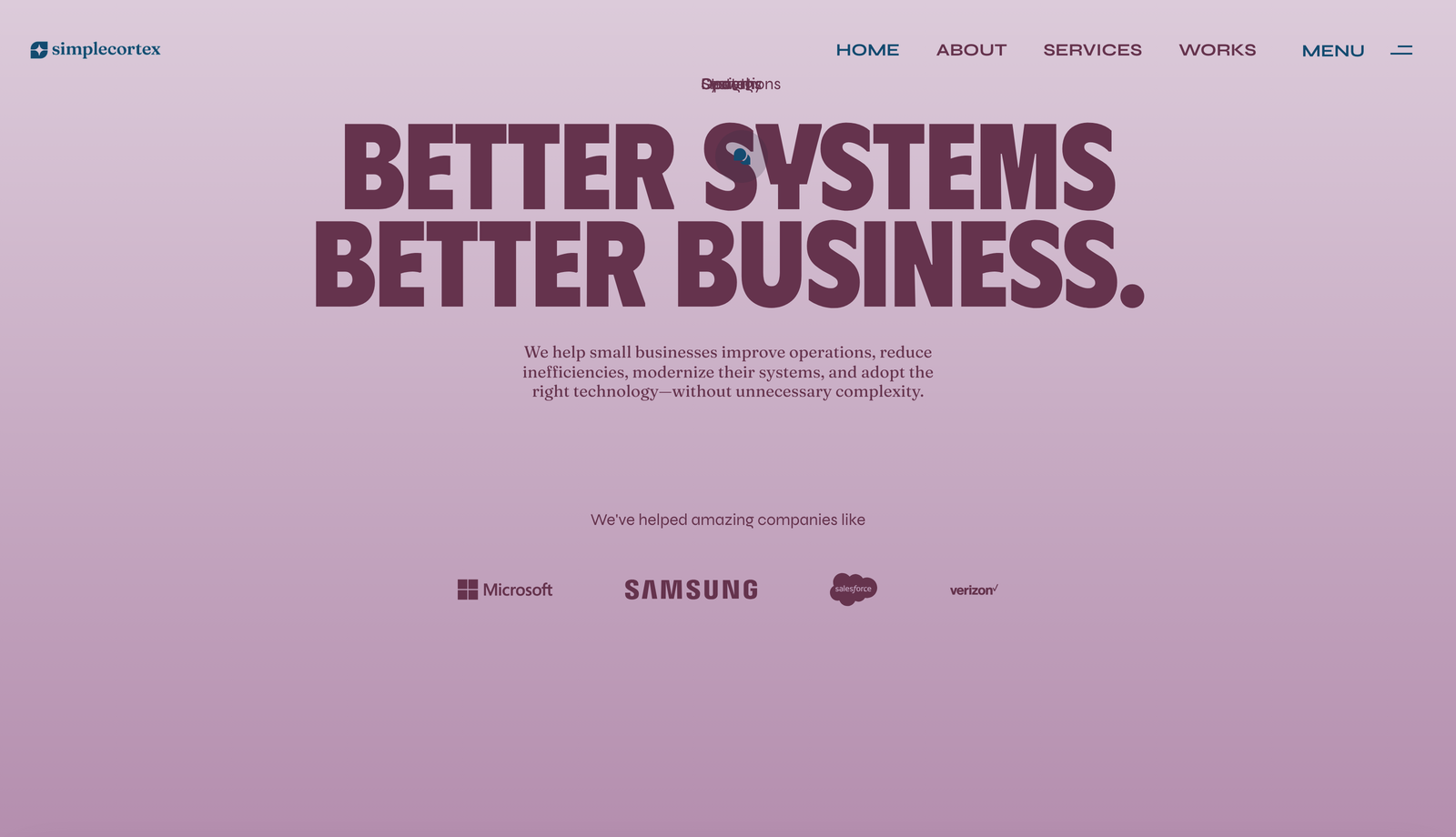
Better systems is what the practice sells. Better business is what the client keeps. The positioning leads with the promise, not a menu of capabilities.
TL;DR
- Role: Founder and Principal
- Timeframe: 2025 to present
- Business problem: Most AI consulting starts with prompts and ends with drift. The missing piece is governance: voice, cost, routing, review, and accountability.
- What I changed: Built an AI consulting practice around local-first model routing, production agents, reusable instructions, and reviewable operating rules.
- Proof: A current AI consulting firm with active client engagements (Kintsu, Safe Driving Academy, eCom Logistics, Little Ghost Coffee) across brand, product, automation, and AI-enabled operating systems.
The problem was not access to AI
Everyone has access now. That is not the hard part.
The hard part is knowing what work goes to which model, what it should cost, what voice it should use, what tools it can touch, and when a human must review. Without answers to those questions, AI fluency is just speed without quality. Engagements drift. Outputs lose consistency. Cost is invisible until it is a problem.
Simple Cortex treats AI like an operating model, not a shortcut. Work is routed. Voice is governed. Instructions are inspectable. Cost is visible. Judgment is designed into the system instead of buried in a prompt.
What I did
- Built the practice around governed delivery, not one-off prompting: agent personas, execution loops, tool surfaces, and review checkpoints all defined as reviewable artifacts committed to version control.
- Designed a local-first routing model that sends work to model paths by task type, cost, and judgment risk, with cloud fallback reserved for cases that need it.
- Created production agent infrastructure for strategy, research, content, and engineering work, each agent defined by a four-file contract so persona, instructions, tools, and execution rhythm are independently reviewable.
- Codified voice, tool access, and decision rules as living documents that any contributor, including AI contributors, reads before touching client work.
- Applied the system across active client engagements in brand, product, automation, and AI-enabled operating systems.
Agents
Router
Models
Agent / CEO
Four files, one contract
What the agent does, in plain prose.
Run the company. Brief the operator. Decide.
Voice, values, decision style.
Default to action. Treat every dollar as a bet.
How a session runs end to end.
Open the brief. Decide. Log the decision.
Which MCP tools and CLIs the agent can call.
ocr route. ocr costs. git. read repo.
What changed
Simple Cortex scales judgment across client work and is the operating discipline behind the current ventures, including the Kintsu Medspa engagement.
The Director-level point: AI fluency is not a model list. It is governance. The practice demonstrates that at the operating level, not just in the pitch.
- Work is routed by task, cost, and judgment risk instead of by habit. Underneath: six semantic routes on the router, local-first with cloud fallback reserved for judgment calls.
- Voice and decision rules are governed and reviewed like code, so quality holds across clients. Underneath: agent voice and decision rules live in version control and get reviewed in pull requests.
- Cost is visible by default, not a surprise on a billing dashboard. Underneath:
ocr costsis a daily-driver command operators run mid-engagement. - Agents are auditable, not opaque. Underneath: three named agents in production, each split into a four-file contract committed to git, so any operator can review persona, instructions, tools, and execution loop through four focused files instead of one monolithic prompt.
Reflection
Simple Cortex supports rather than competes with the product work. AI scales speed only if you design the rules that keep quality intact. A practice that runs lean on governed local inference can sell that discipline back to its clients, not just the output.
At Director scale the next move is pulling the persona and voice files into a shared style guide so every new agent inherits the rules by default, the same way a design system enforces token discipline across components.